
Most sushi menus in Europe are built on Norwegian salmon. The Mediterranean has its own raw-fish tradition and its own sushi-grade fish, and some of the best of it is caught around Sardinia. Below: which fish they are, how they are caught and regulated, and what you actually see of them on a day at sea in the La Maddalena archipelago.
Bluefin tuna and the tonnare of south-west Sardinia
Atlantic bluefin tuna (Thunnus thynnus) swims into the Mediterranean in late spring to spawn. For centuries Sardinia caught it with the tonnara, a fixed system of nets anchored near the coast that guides the fish into a final chamber. A few still work today, the best known at Carloforte on the island of San Pietro. Japan has long been one of the main markets for Mediterranean bluefin, where it ends up as maguro and as the fatty toro cuts.
Bluefin was heavily overfished at the end of the last century. Since then catches have been fixed every year by quota through ICCAT, the International Commission for the Conservation of Atlantic Tunas, and the eastern Atlantic and Mediterranean stock has recovered under that system. You can read more about Carloforte and the island of San Pietro on Sardegna Turismo, the region’s official tourism site.
Amberjack: the Mediterranean kanpachi
Greater amberjack (Seriola dumerili), ricciola in Italian, is the same species Japanese chefs call kanpachi. Its firm, pale flesh is a standard of Italian crudo. A close relative, the Japanese amberjack (Seriola quinqueradiata), is the hamachi or yellowtail found on sushi menus everywhere. In summer, amberjack hunt along the reefs and rocky points of northern Sardinia.
Crudo: the Italian way of eating raw fish
In Sardinia raw fish is usually served as crudo: thin slices of sea bream, sea bass, tuna or amberjack, red prawns, with olive oil, lemon and salt instead of rice, soy and wasabi. The fish and the knife work are close to sashimi; the seasoning is Mediterranean.
Raw fish and EU rules
In the European Union, wild fish meant to be eaten raw generally has to be frozen first to kill parasites such as anisakis: at least −20 °C for 24 hours, or −35 °C for 15 hours. The rule is in Regulation (EC) No 853/2004 and applies to sushi bars and crudo alike. That is why “fresh” and “frozen” are not opposites on a sushi menu: good raw fish has usually been both.
The same fish in other kitchens
Around the Mediterranean and the Adriatic, Japanese technique and local produce meet in different ways. In Albania, for example, Ginger Sushi in Tirana serves nigiri, special rolls, tartare and poke bowls, with a few Korean dishes on the menu, and delivers within the city’s ring road. If you travel between the Balkans and Sardinia, comparing a Tirana sushi menu with a plate of Sardinian crudo is a simple way to taste how the same fish changes with the kitchen.
What you see of it from a boat in La Maddalena
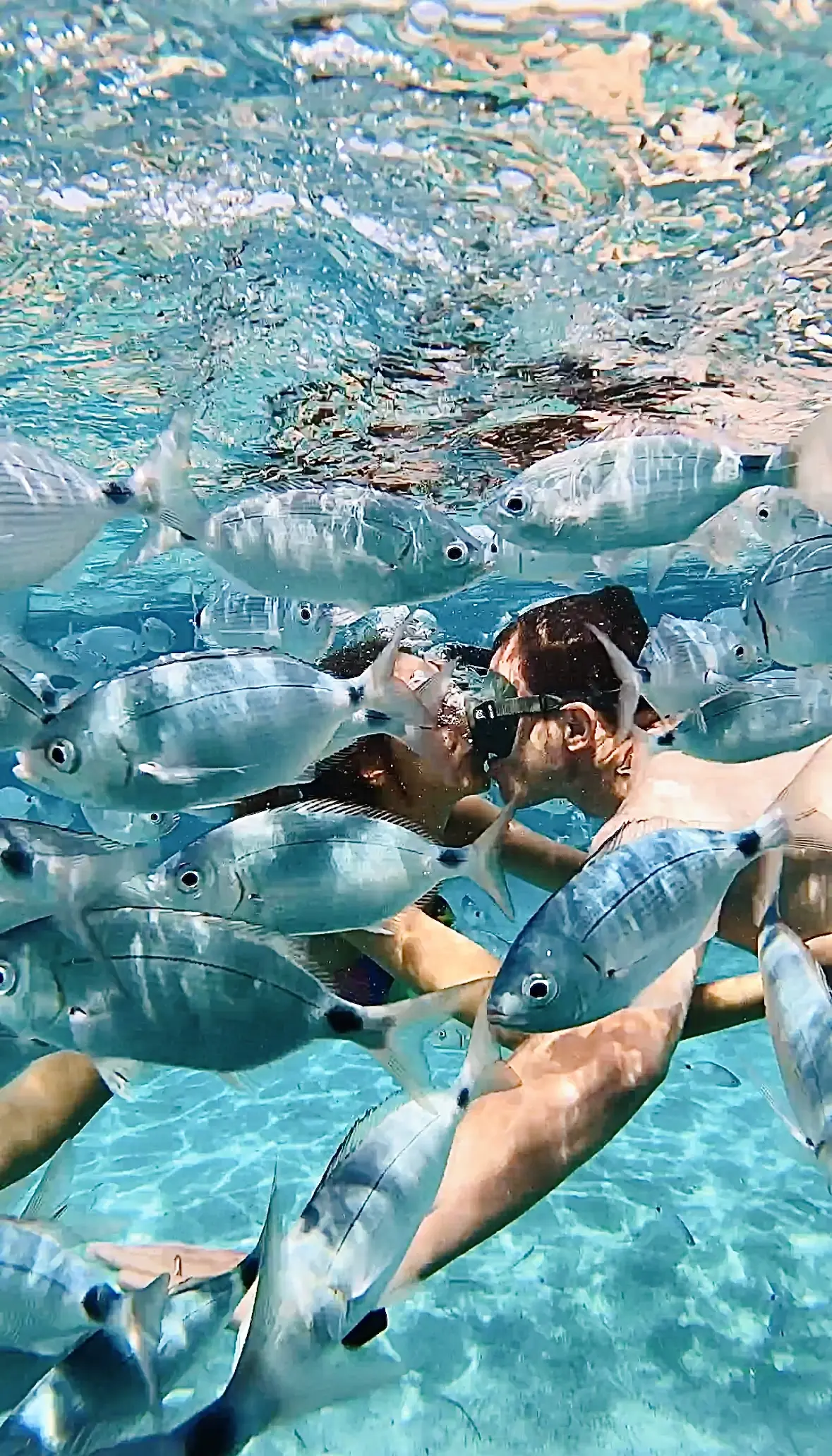
The archipelago is a national park, and fishing is restricted in large parts of it; the rules change by zone, so check the La Maddalena National Park website before you fish. Tuna and amberjack are open-sea fish and you are unlikely to meet them while snorkelling. In the shallow coves of Spargi and Caprera you mostly see sea bream, damselfish and wrasse over sand and granite.
Our half-day small-group tour and the private boat tour both stop for swimming and snorkelling. There is no lunch on board: on the private tour you can bring your own packed lunch, and there is a fridge. For dinner, the restaurants in La Maddalena town and in Palau serve the local catch, raw or cooked.